Pipe-Strap vs Clamp-On Sensor: The Buyer's Call
Jul 22, 2026"Pipe-strap" and "clamp-on" get used interchangeably in catalogues, which is unhelpful, because the difference is mechanical and it decides how the sensor fails. Both press a sensing element against a pipe from outside. What differs is what supplies the force — and force, contact area and repeatability are the whole game in surface sensing.
| Strap-mount | Spring clamp | Threaded / immersion | |
|---|---|---|---|
| Force source | Tensioned strap, ratchet-locked | Pre-formed spring steel | Thread + seal |
| Pipe size range | Wide — one part covers a range | Narrow — sized per diameter | Fixed fitting |
| Refit by hand | Possible; tension is operator-dependent | Designed for it | Needs draining |
| Contact repeatability | Depends on who fitted it | High — the spring sets the force | Not applicable |
| Measures | Pipe surface | Pipe surface | The medium |
| Break into the pipe? | No | No | Yes |
The buyer's question is rarely "which is better". It is "which one is still reading correctly in three years" — and there the answers diverge sharply.
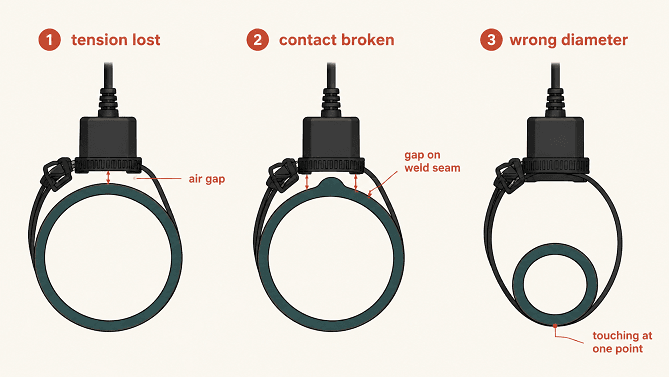
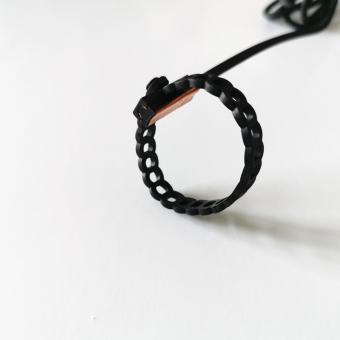
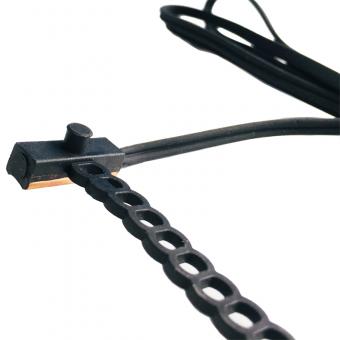
A strap is only as good as the force still in it. Thermal cycling and vibration walk a smooth strap loose. This is exactly why the TPE strap on the Focusensing pipe-clamp carries locking holes on a 4.5 mm pitch — ratchet geometry that holds tension once seated instead of relying on friction. (Pipe-strap product documentation.) If you are evaluating a smooth-band competitor, that is the question to ask.
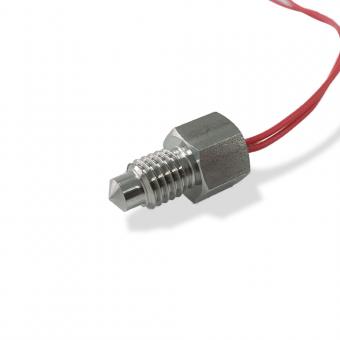
Specify a copper-capped tip for its thermal path, then mount it over a weld seam or a burr, and you have bought a copper cap and installed an air gap. Contact is not binary. A copper tip held 0.3 mm off the pipe performs like a polymer tip and costs more.
The general practice here is covered properly in Thermistor Mounting 101 — best practices for accurate temperature measurement. If you fit sensors, read that one before this one.
A strap sized for 35 mm on a 12 mm line contacts the pipe on a tangent — a line, not a patch. It reads, it just reads slowly and toward ambient. Spring clamps fail the opposite way: right diameter, perfect contact, wrong part on the next pipe size, so the store carries five SKUs.
The integrated TPE strap is 110 ± 10 mm long and 7.0 ± 0.2 mm wide, covering pipe outer diameters up to about 35 mm. Past that, a buckle-on extension strap extends the range — that is the extension-chain version. Probe nose length is 6.0 ± 0.5 mm. (Pipe-strap product documentation.)
This is where strap-mount wins commercially, and it has nothing to do with physics: one part number covers a diameter range instead of a diameter. On a building with 12 mm branches and 32 mm risers, that is one line on the BOM instead of three, one part in the van, one thing to get wrong.
Strap dimensions, locking pitch and probe nose length are from the Focusensing pipe-strap product documentation. Ingress ratings and operating temperature range differ between the pipe-strap documentation and the product catalogue and are therefore not quoted here — request the current datasheet and specify against that.
Request the current datasheet → · Discuss your application →
No.1 XiSan Road, Electromechanical Industry Park , High&New Tech.Zone. Hefei,Anhui,China
teléfono : +86-551-69109668
Whatsapp : +86-13339100504
Email : info@focusens.com
Skype : melodyliu520






 +86-551-69109668